

The Difference Between Behaviour Support and Restrictive Practice
Understanding the difference between behaviour support and restrictive practice is critical for anyone involved in NDIS-funded disability support. While the two concepts are related, they are fundamentally different in purpose, approach, and legal requirements. Confusing them can lead to misuse of restrictive practices, regulatory breaches, and harm to participants.
This article explains the differences, why behaviour support is central to reducing restrictive practices, and what providers, support workers, and families need to know to remain compliant and provide ethical care.
What Is Behaviour Support?
Behaviour support is a proactive, person-centred approach aimed at understanding and addressing behaviours of concern. Its primary goal is to improve quality of life, promote independence, and reduce the likelihood of behaviours that could cause harm.
Key features of behaviour support include:
- Assessment of triggers and causes of behaviours
- Development of positive behaviour support strategies
- Emphasis on skill-building, communication, and environmental modification
- Monitoring and ongoing evaluation of outcomes
Behaviour support is not about controlling a person’s behaviour through restriction. Instead, it focuses on prevention, support, and empowerment.
What Is a Restrictive Practice?
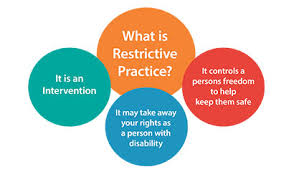
A restrictive practice is any intervention that limits a person’s rights, freedom, or movement, often to prevent harm. Unlike behaviour support, restrictive practices are reactive and high-risk, and they must only be used as a last resort.
Common types of restrictive practices include:
- Physical restraint – using force to restrict movement
- Chemical restraint – medication used to control behaviour
- Mechanical restraint – devices that limit movement (not for therapeutic reasons)
- Seclusion – confining a person in a space they cannot leave freely
- Environmental restraint – restricting access to objects, spaces, or activities
Restrictive practices carry legal, ethical, and human rights implications. They are highly regulated under the NDIS and must be authorised in a Behaviour Support Plan.
Key Differences Between Behaviour Support and Restrictive Practices
While behaviour support and restrictive practices intersect, there are clear differences:
| Feature | Behaviour Support | Restrictive Practice |
|---|---|---|
| Goal | Improve quality of life and prevent behaviours of concern | Control behaviour or prevent immediate harm |
| Approach | Proactive, person-centred, skill-building | Reactive, controlling, intervention-focused |
| Use | Always allowed and encouraged | Only allowed when authorised and as a last resort |
| Focus | Understanding triggers and teaching coping skills | Limiting movement or freedom |
| Legal Requirement | No special authorisation required | Must be documented in an approved Behaviour Support Plan |
| Ethics | Promotes autonomy and dignity | Can reduce autonomy and has ethical risks |
The table highlights that behaviour support minimises the need for restrictive practices, whereas restrictive practices must always follow behaviour support planning.
The Role of Behaviour Support in Reducing Restrictive Practices
One of the key objectives of the NDIS is to reduce and eventually eliminate restrictive practices wherever possible. Behaviour support is central to this goal.
Through behaviour support, providers can:
- Identify triggers and risk factors for behaviours of concern
- Implement preventative strategies before harmful behaviour occurs
- Develop alternative communication and coping skills for participants
- Modify environments to reduce stress and prevent escalation
Effectively applied behaviour support reduces reliance on restrictive interventions, improving safety, autonomy, and quality of life.
Legal and Regulatory Context
The NDIS regulates restrictive practices through several mechanisms:
- NDIS Act 2013
- NDIS (Restrictive Practices and Behaviour Support) Rules
- NDIS Quality and Safeguards Framework
Behaviour support, while not a restrictive practice itself, is legally required to justify any restrictive intervention.
Key legal points:
- Restrictive practices must only be used when authorised in a Behaviour Support Plan.
- Behaviour support plans are mandatory for participants who require regulated restrictive practices.
- Unapproved use of restrictive practices is considered a compliance breach.
Providers must understand that behaviour support is preventive, while restrictive practices are reactive and highly regulated.
Provider Responsibilities
Providers play a critical role in ensuring the difference between behaviour support and restrictive practices is understood and applied correctly. Responsibilities include:
- Training staff on behaviour support principles and recognising restrictive practices
- Implementing Behaviour Support Plans accurately
- Monitoring use of restrictive practices and reporting to the NDIS Commission
- Ensuring reduction and elimination strategies are embedded in practice
- Engaging participants and families in decision-making and planning
By prioritising behaviour support, providers can reduce risk, enhance compliance, and protect participant rights.
Risks of Misunderstanding the Difference
Misinterpreting behaviour support as a licence to use restrictive practices can have serious consequences:
- Harm to participants through unnecessary restriction
- Non-compliance with NDIS rules
- Regulatory sanctions or provider deregistration
- Damage to trust and reputation
Clear understanding and training are essential to ensure ethically and legally sound practice.
Case Study Example (Illustrative)
Scenario: A participant becomes anxious and displays behaviours that could cause harm.
- Restrictive practice response: Staff immediately use physical restraint to control behaviour.
- Behaviour support response: Staff follow a behaviour support plan that includes calming strategies, environmental adjustments, and communication tools, preventing the escalation.
This example shows that behaviour support can often prevent the need for restrictive interventions, supporting participant safety and autonomy.
Integrating Behaviour Support and Restrictive Practices
In situations where restrictive practices are unavoidable:
- They must be included in a Behaviour Support Plan
- They must be time-limited, proportionate, and regularly reviewed
- Behaviour support should include strategies to reduce reliance on restriction
Effectively, behaviour support guides safe and lawful use of restrictive practices, making the two complementary when applied correctly.
Promoting a Rights-Based Approach
Behaviour support embodies a human-rights approach:
- Supports autonomy and choice
- Reduces trauma associated with restrictive practices
- Encourages inclusive, respectful care
Restrictive practices, by contrast, should always be temporary, justified, and monitored to ensure participants’ rights are protected.
Conclusion
The difference between behaviour support and restrictive practice is critical for providers, participants, and families.
- Behaviour support: proactive, empowering, skill-building, preventive
- Restrictive practice: reactive, high-risk, requires authorisation, last resort
Understanding this distinction helps providers reduce harm, remain compliant with NDIS rules, and protect human rights. Integrating behaviour support effectively can minimise restrictive practice use, improve participant outcomes, and promote safer, more ethical disability support.